

Weaving history, questioning the present
By Marco Costantini and Magali Junet

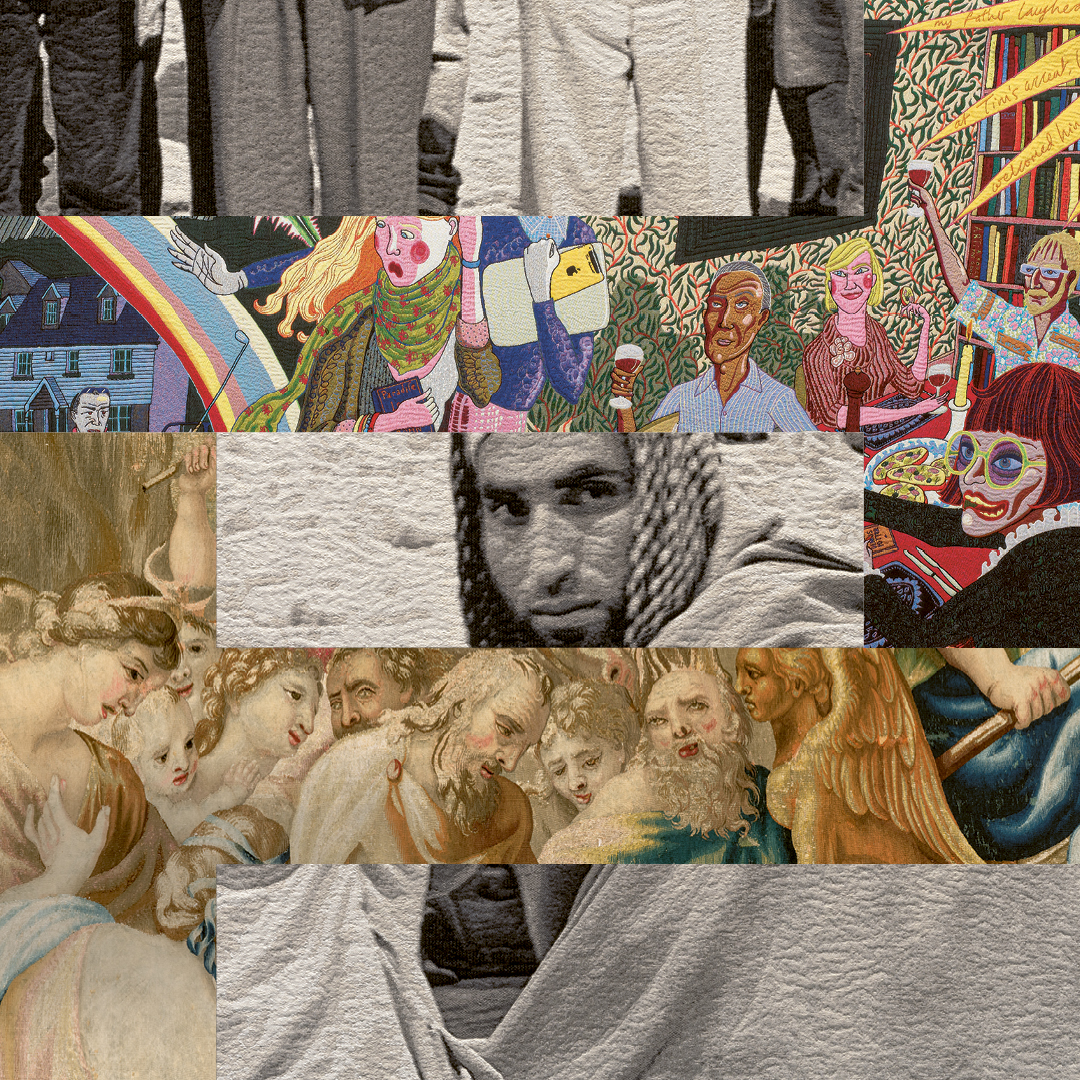
Le Triomphe de Titus et Vespasien, tenture de l’Histoire de Titus et Vespasien, 1668-1688, manufacture de Guillaume van Leefdaal d’après le modèle de Charles Poerson
© Fondation Toms Pauli Lausanne, acquisition 2023
« Tapestry is in essence a spectacle whose backstage should be explored »
Pierre Pauli[1]
A powerful instrument of communication, tapestry has never lost its expressive force. Over the centuries, it has maintained the enduring relevance of its role as a medium for the transmission of political and social discourse, and as an art form that reflects the ambitions and concerns of its time. During the Middle Ages and the Renaissance, magnificent tapestries were displayed in places of power—royal, princely, and ecclesiastical—where they served ostentatious, decorative, symbolic, and didactic purposes. Some were portable, designed to accompany sovereigns on their travels, functioning as mobile galleries of historical narratives and contemporary aspirations. Beyond their primary functions of thermal insulation and celebrated ornamentation, commissioned by the elites, these works operated as instruments of political, economic, or moral self-affirmation.
The famous Bayeux Tapestry, a long, embroidered cloth produced in the eleventh century, is an example of a visual narration of the Norman conquest of England in 1066. Not only does it recount an historical event, it also disseminates political propaganda in favour of William the Conqueror. Similarly, the Conquest of Tunis tapestry, woven around 1550 in Brussels, commemorates the military talents of Emperor Charles V in his military campaign against the corsair Barbarossa. Numerous other Renaissance and Baroque series depict the heroic exploits of Roman emperors and generals—Alexander, Constantine, Scipio Africanus, Titus, and Vespasian whose glorious deeds were intended to reflect and magnify the prestige of their patrons. For example, the Acts of Scipio Africanus tapestries were first woven for Francis I of France between 1532 and 1535 and re-woven several times over two centuries, including around 1660 for Luis Francisco de Benavides Carrillo de Toledo, Marquis of Caracena and Governor of the Spanish Netherlands[2].
Tapestry has also served as a vehicle of declaration and persuasion. Operating as a double mirror, a reflection both of the times of the subject matter and those of the making, the woven narrative acts as a tool for fixing memory, offering a version of the past aligned with the personal and political interests of its patron. Detached from its historical status as a rare and luxurious object, tapestry experienced an unexpected revival after the Second World War, initially driven by celebrated French cartoon painters and weavers, and later by younger, male and female artists, especially from Central Europe, who in the late 1960s began to view thread—in various and often unconventional materials—as a medium capable of articulating a new artistic language. In doing so, they challenged the divide between the applied arts and contemporary art, between decoration, politics, and society. Tapestry and textile art thus inaugurated a spectacular, near-limitless era of experimentation and creation, notably energised by the Lausanne International Tapestry Biennials (1962–1995), which became a vital platform for artists and cultural institutions.
Over the past fifteen years, tapestry has enjoyed a significant resurgence of interest and visibility in the field of contemporary art, thanks to the work of a new generation of exhibition and collection curators, and artists from a wide range of disciplines and backgrounds[3]. The medium appeals to many multidisciplinary practitioners who, whether weaving themselves or employing digital technologies, explore expressive and representational forms at the intersection of ancestral craftsmanship and a decisively modern and innovative vision.
One of the most striking aspects of this revival is the increasingly critical and socially engaged role of tapestry—an orientation rarely seen before the twentieth century. In contrast to its traditional association with self-proclamations of power and prestige, tapestry in the twentieth and twenty-first centuries has become a tool for revisiting, questioning, and even denouncing political and social issues. These include matters of identity, freedom of expression, class, and gender, as well as broader societal, environmental, and artistic concerns. Having regained prominence on the art scene, tapestry is reasserting its dual function both as a decoration and as a powerful medium of communication—propagandistic in its traditional role, and focused on observation and critique in its more contemporary expression.

Goshka Macuga, Death of Marxism, Women of All Lands Unite, 2013
© Courtesy of the artist and Andrew Kreps Gallery, New York © Goshka Macuga/2025, ProLitteris

Grayson Perry, The Upper Class at Bay de la série The Vanity of Small Differences, 2012
© Grayson Perry. Courtesy of the artist and Victoria Miro

Goshka Macuga, Of what is, that it is, of what is not, that it is not 1, 2012
© Pinault Collection. Photo © Nicolas Brasseur © Goshka Macuga/2025, ProLitteris

Grayson Perry, The Adoration of the Cage Fighters de la série The Vanity of Small Differences, 2012
© Grayson Perry. Courtesy of the artist and Victoria Miro
In this renewed textile landscape, Grayson Perry and Goshka Macuga stand as pioneering figures. Through their monumental wall tapestries, they were among the first to interrogate and visualise the narratives and tensions of twentieth and twenty-first-century history—their social and political struggles, also personal, communal and universal. Alongside them, or in their wake, other artists—such as Tracey Emin, William Kentridge, Otobong Nkanga, Ir.ne Kopelman, Laure Prouvost, and Małgorzata Mirga-Tas to name but a few—have embraced tapestry with conviction and force as a medium to assert their perspectives on society, art, and the world. Often working in collaboration with specialised weaving studios, whether artisanal or digital, these artists create works animated by that same commitment to aesthetic experimentation and socio-political commentary. Their woven productions constitute a significant contribution to the ongoing movement to rehabilitate craft practices within contemporary art. The interplay between classical tradition and technological innovation, glorification and critique, is also helping to reposition tapestry as a medium of particular relevance in today’s international art landscape.
In Perry and Macuga’s work, the glorious narratives of antiquity—those of Scipio and Hannibal, the triumphs of Titus and Vespasian, and the renowned cycles of the Life of Noah or the Acts of the Apostles—give way to more subtle alternative stories and practices. Perry draws inspiration from medieval and Renaissance narrative tapestries and paintings to create contemporary allegories imbued with pointed critiques of Britain’s social, identity, and consumer cultures. Macuga, on the other hand, approaches tapestry as a form of visual archive—an assemblage of moments from the past and present, designed to re-examine the mechanisms underpinning power structures and collective memory. Both artists construct rich tableaux that strike and intrigue, in which historical, allegorical, and contemporary figures, including public personalities, close friends or relations, and even self-portraits, converge. These impossible encounters generate layered worlds that invite viewers to engage in historical, philosophical, and aesthetic dialogue through the tapestries and their specific spatial installations.
The woven works of Macuga and Perry are firmly anchored in the present, demonstrating that the medium of tapestry can be as incisive and meaningful as any other form of contemporary art. The Polish artist’s Of what is, that it is; of what is not, that it is not (2012) and the British artist’s The Vanity of Small Differences (2012) stand as biting critiques and observations of contemporary culture.
Mechanically woven on digital Jacquard looms and developed in collaboration with specialist programmers, the tapestries of Macuga and Perry require lengthy design and experimentation processes. Nonetheless, they are considerably less costly and quicker to produce than the monumental series of earlier centuries.
By reinventing the relationships between tradition and modernity, memory and testimony, twenty-first-century tapestry reaffirms its status as a living, increasingly relevant medium—one that offers a material and tangible alternative to the saturation of digital imagery in our everyday lives. The Times in Tapestry exhibition thus positions itself as an affirmation of the richness and complexity of the tapestry medium in the context of the present century. By bringing together works that engage in dialogue with the past while probing present-day issues, the exhibition bears witness to the vitality of the medium and its capacity to mobilise techniques, forms, and narratives with renewed force. Whether personal fictions, collective chronicles, or global critiques, the exhibited tapestries, each in their own way, continue the legacy of woven narratives, endowing it with a new urgency. Times in Tapestry invites us to view tapestry as a site of thought, knowledge, and exchange—a space where memory, commitment, and creativity converge in a medium that is simultaneously artwork, message, discourse, and monument
This article can be found in the Times in Tapestry box about the exhibition. Available in the bookshop.